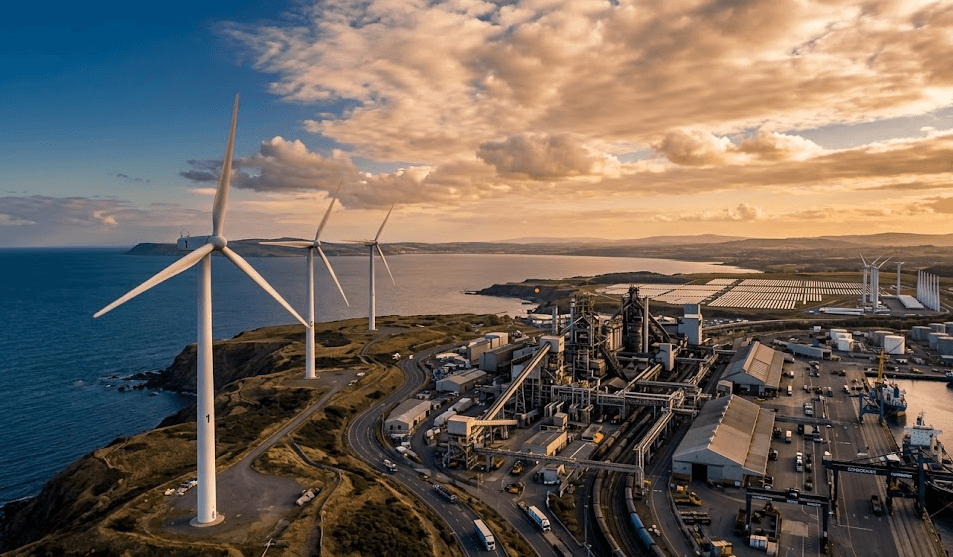
Why Heavy Industries Are Investing in Commercial Wind Turbines in 2026
Heavy industries are investing in Commercial Wind Turbines because controlling energy costs, ensuring power reliability, and reducing carbon emissions have become strategic business priorities. For manufacturing plants, mining operations, steel facilities, logistics hubs, and industrial parks, wind power can help reduce reliance on grid electricity while supporting more stable, cleaner operations.
Commercial wind turbines are important to heavy industry
Energy-intensive industries consume power at a scale where small price swings create a major budget impact. A steel plant running around the clock can’t afford to depend on a grid supply that’s costly and unpredictable. Neither can a mining operation in a remote region.
Commercial wind turbines make on-site or near-site power generation possible at an industrial scale. Unlike rooftop solar, utility-scale wind assets can offset a significant share of a large facility’s demand. In some cases, they cover the majority of it.
Industrial parks and logistics hubs face the same challenge. They have large land footprints, consistent energy loads, and long operational lifespans. Those are exactly the conditions that favour wind energy investment.
Lower Long-Term Energy Costs
The upfront capital cost of commercial wind infrastructure is real. But the long-term economics tend to favour the investment. This is especially true for facilities with high, predictable electricity consumption.
Once turbines are installed, the cost of generation drops sharply. There’s no fuel to buy. Maintenance costs are manageable relative to the volume of energy produced.
Electricity tariffs are rising in many markets. Rising electricity costs for energy-intensive industries, fuel price volatility, grid upgrades, and carbon levies are all pushing costs higher. Owning wind assets locks in a portion of your supply and acts as a hedge against those increases. For manufacturers and industrial operators on tight margins, that cost certainty has real strategic value.
Power purchase agreements (PPAs) offer another route. They allow companies to access wind-generated electricity without owning turbines outright. This lowers the barrier to entry considerably.
Stronger Energy Resilience for Industrial Facilities
Grid reliability is a growing concern for industrial operators. Ageing transmission infrastructure and extreme weather events are causing more frequent disruptions. Peak demand stress is adding further strain.
For operations where downtime is expensive, energy resilience is a risk management issue. This applies to mining processing facilities, chemical plants, and continuous manufacturing lines alike.
Commercial wind turbines reduce dependence on the grid. When paired with battery storage or backup generation, they allow facilities to maintain partial operations during disruptions. That level of energy independence is increasingly factored into capital planning.
Sustainability Pressure and Carbon Reduction
Industrial companies face pressure from customers, investors, and regulators to cut their carbon footprint. Scope 2 emissions — those tied to purchased electricity — are a logical first target. Wind energy addresses them directly.
Many heavy industries are working toward net-zero commitments with near-term milestones. Commercial wind projects provide verifiable, large-scale renewable generation. That output can be attributed directly to a facility’s operations. It supports internal reporting and third-party certification requirements.
Carbon offsets are facing growing scrutiny. On-site or contracted wind generation represents a real operational change — not just an accounting adjustment. That distinction matters to enterprise customers and ESG auditors.
What to Consider Before Investing
Wind resource assessment is the starting point. Not every site has the right wind profile. A proper feasibility study is essential before committing capital.
Grid interconnection, permitting timelines, and zoning rules vary by region. Industrial buyers need to factor these into project schedules from the start.
There are also structural decisions to make. Owning turbines outright, entering a PPA, and joining a community wind project each have different financial and operational implications. An experienced energy advisor can help match the right structure to your business model.
Commercial Wind Turbines Are Becoming a Strategic Energy Asset
In 2026, investment in commercial wind turbines among heavy industries reflects a shift in how operational leadership thinks about energy — less as a fixed overhead cost and more as a manageable, strategic input.
For manufacturing, mining, steel, and logistics operations with the right site conditions and long enough planning horizons, wind energy is worth a serious look. The question is less about whether it makes sense and more about how to structure it correctly.
