How much does a commercial solar energy system cost?
For any CFO or facility manager, the upfront capital expenditure is the first question. Basically, commercial solar is a major infrastructure investment, and an uncontextualized quote can look intimidating. Therefore, this guide breaks down what drives commercial solar cost and how the 30% ITC reduces the net figure. Realistic payback timelines are covered, too. Ultimately, the goal is to give you a financial framework to evaluate solar as a CapEx decision — not a green gesture.
How Much Does a Commercial Solar Energy System Cost?
The cost of a commercial solar energy system typically ranges from $1.00 to $2.50 per watt before tax incentives. For a standard 100kW facility, this translates to an initial investment of $100,000 to $250,000, which is significantly reduced by federal tax credits. For facilities evaluating battery backup alongside solar, see our detailed breakdown of hybrid energy storage costs and ROI.
What Drives the Final Commercial Solar Cost?
The per-watt figure above is a starting range, not a fixed price. Furthermore, three variables move that number significantly in either direction for any specific facility.
The 3 Main Factors That Affect Your Commercial Solar Price
System Size: Larger systems cost less per watt. This is a direct function of procurement economics and installation efficiency. Specifically:
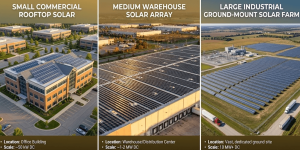
- 25–100 kW (small commercial): $1.80–$2.50/W installed. Typical for small offices, retail, and light manufacturing
- 100–500 kW (mid-market): $1.40–$1.90/W installed. Standard for warehouses, distribution centres, and mid-sized factories
- 500 kW–2 MW (large commercial/industrial): $1.10–$1.50/W installed. Industrial facilities, large CRE portfolios, and campus-scale deployments
Roof Condition and Mounting Type: Not all rooftops are equal, and installation complexity directly affects labour cost. Consequently, three mounting scenarios carry different price implications:
- Standard flat roof ballasted mount — Lowest installation cost. Most commercial and industrial rooftops qualify. No roof penetrations required on many ballasted systems
- Pitched or metal standing seam roof — Moderate cost premium. Specialised racking required; installation labour increases 10–20%
- Ground-mount array — Highest installation cost due to civil work, trenching, and conduit runs. However, ground mounts allow optimal panel orientation and are unconstrained by roof condition or load ratings
Additionally, older roofs that require structural reinforcement or replacement before installation add $15,000–$60,000 in pre-solar CapEx, depending on roof area and condition.
Addition of Hybrid Energy Storage: Adding battery storage is the single largest cost variable after system size. Indeed, a commercial battery bank for 4 hours of backup on a 100 kW facility typically adds $150,000–$300,000 gross. That figure is before incentives.
However, the financial case for solar-plus-storage has strengthened considerably:
- Battery storage now qualifies for the same 30% federal ITC as the solar array
- Peak shaving via battery discharge can reduce monthly demand charges by 15–40%
- Grid backup eliminates the need for diesel generators and their ongoing fuel and maintenance costs
Accordingly, for facilities with high demand charges or critical uptime requirements, the hybrid storage premium frequently pays back independently of the solar ROI.

How the 2026 ITC Cuts Your Commercial Solar Cost
The gross installation price is only half the story. Federal tax policy significantly changes the net CapEx for any commercial solar project that begins construction in 2026.
The Investment Tax Credit: What the 30% Really Means for Your Business
The federal Investment Tax Credit (ITC) provides a 30% tax credit on the total installed system cost for businesses beginning construction in 2026. Panels, inverters, racking, wiring, and labour all qualify. The base 30% credit is confirmed under current federal policy — for the full legislative history and eligibility requirements, see the Solar Energy Industries Association.
This is a dollar-for-dollar reduction in your federal tax liability, not a deduction. Consider a straightforward example. Bonus adders can increase the effective credit rate beyond the base 30%:
- Gross system cost: $200,000
- 30% ITC credit: −$60,000
- Net cost after ITC: $140,000
Beyond the base rate, bonus adders can stack for further savings:
- +10% Domestic Content Adder — If system components meet domestic manufacturing requirements
- +10% Energy Community Adder — Facilities located in designated energy communities (coal closure zones, brownfields)
- +10–20% Low-Income Community Adder — For qualifying projects in low-income areas
Moreover, commercial solar systems also qualify for MACRS 5-year accelerated depreciation. MACRS depreciation on a $200,000 system generates approximately $40,000–$56,000 in additional tax savings over 5 years. The exact figure depends on the corporate tax rate. Combined with the ITC, a $100,000 installation can have an effective net cost of $45,000–$52,000. That accounts for all applicable federal tax benefits.
Critical 2026 deadline: Projects must begin construction before July 4, 2026, or be placed in service by December 31, 2027, to qualify for ITC eligibility under current policy. This compressed timeline makes early planning essential.
What Does the Payback Period Look Like?
After applying the 30% ITC and MACRS depreciation, most commercial solar systems achieve a simple payback in 3–7 years. The specific range depends on:
- Local utility rates and time-of-use tariff structure
- Net metering policy in the facility’s utility territory
- Whether battery storage is included and demand charge exposure
- Annual system degradation (typically 0.5% per year on quality panels)
Furthermore, commercial solar panels carry standard 25-year performance warranties. A system with a 5-year payback delivers approximately 20 years of net positive cash flow. That makes commercial solar cost one of the better-characterised CapEx decisions available to North American operators.
Commercial Solar Cost Is a Starting Point, Not a Fixed Number
The $1.00–$2.50/W range gives CFOs and facility managers a working budget framework. Moreover, after the 30% ITC and MACRS depreciation, the effective net cost typically lands at 40–55% of the gross installation price. Consequently, facilities delaying solar procurement face two compounding risks. Net cost rises as the ITC deadline approaches. Additionally, utility rate exposure averages 2–4% annually. Ultimately, the most accurate commercial solar cost figure comes from your actual load data and roof conditions. A generic per-watt benchmark is a starting point, not a final answer.
