How Hybrid Energy Storage Beats High Commercial Energy Costs in 2026
Commercial energy costs are rising — unevenly. Basically, it is not just the rate per kilowatt-hour that hurts. Peak demand charges now account for 30–70% of a typical North American commercial electricity bill. Therefore, facility managers and procurement directors are searching for a smarter power strategy. Hybrid energy storage changes that equation. Ultimately, it gives businesses direct control over when and how they consume grid power — and what it costs.
What Is Hybrid Energy Storage?
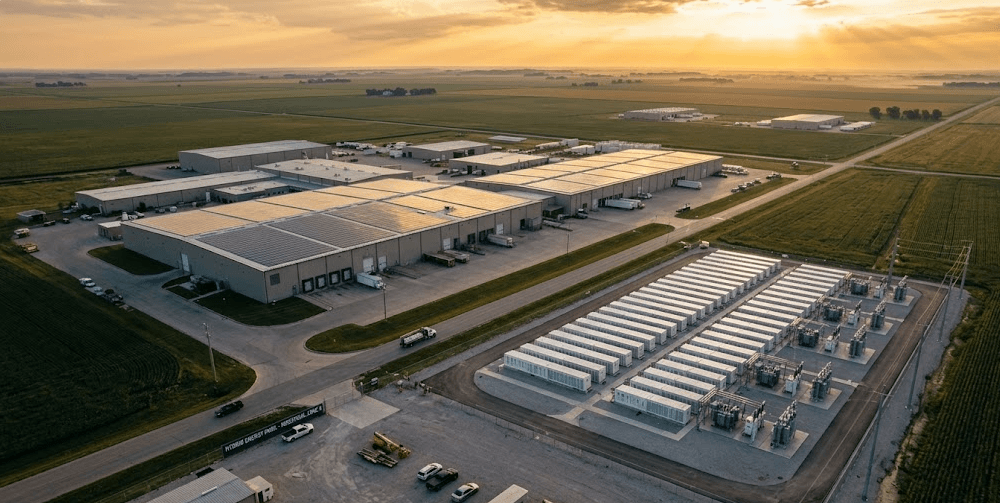
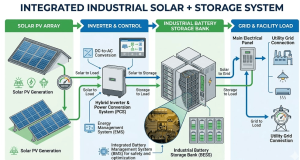
Hybrid energy storage is an advanced commercial power system that integrates renewable generation, like solar panels, with industrial-grade battery systems. It captures and stores excess energy, allowing facilities to bypass expensive peak utility rates and maintain continuous operations during unforeseen grid outages.
Why Choose Hybrid Energy Storage Over Grid-Only Power?
Grid infrastructure is aging. Furthermore, rate structures are growing more complex, and extreme weather is pushing outage frequency higher. Consequently, grid-only facilities absorb every one of these risks with no buffer.
Here is the commercial logic for making the switch:
- Peak shaving reduces your highest 15-minute demand interval, directly cutting how utilities calculate your monthly demand charge.
- Time-of-use arbitrage charges batteries at off-peak rates and draws stored power during expensive on-peak windows.
- Solar self-consumption captures generation that would otherwise be exported at unfavorable rates and delivers it at full retail value.
- Seamless backup power eliminates dependence on diesel generators — along with their fuel, maintenance, and compliance costs.
Grid-Only vs. Commercial Battery Storage System: Side-by-Side
| Operational Factor | Grid-Only Power | Hybrid Energy Storage System |
|---|---|---|
| Peak Demand Charges | Paid in full every billing cycle | Reduced 15–40% through active peak shaving |
| Time-of-Use Rate Exposure | Full exposure to on-peak pricing | Mitigated with stored off-peak energy |
| Outage Response | Operations halt or switch to diesel | Battery switchover in milliseconds — zero disruption |
| Energy Cost Predictability | Variable — tracks utility rate increases (avg. 2–4%/yr) | Stabilized — partially insulated from grid pricing |
| Federal Tax Incentives | None available | 30% ITC; up to 40% with domestic content bonus |
| Payback Period | No investment, no return | Typically 4–6 years, depending on load profile |
Battery Costs Have Reached a Commercial Tipping Point
Installed hybrid energy storage system costs in the U.S. are landing in the $350–$550/kWh range for most mid-market projects — roughly a 40% reduction from 2021 levels. Additionally, the federal Investment Tax Credit covers 30% of installed costs — a provision unavailable before 2023. Facilities in energy communities can stack a 10% bonus, and domestic content projects access an effective 40% credit. In short, the financial case has never been cleaner.
The Case for Cutting Monthly Overheads
North American utilities are restructuring rate designs. They are recovering grid investment through demand charges rather than per-kWh rates. Indeed, this shift penalizes facilities that experience even brief consumption spikes. By discharging stored energy during high-demand intervals, companies therefore save thousands of dollars monthly on demand charges alone.
Moreover, the spread between peak and off-peak pricing has widened sharply across most industrial zones. Acting now locks in cost certainty before rate structures tighten further.
Why Operational Continuity Requires a New Approach
After all, power interruptions cost North American manufacturers an estimated $150 billion annually. Similarly, a single outage in cold storage or manufacturing can erase a week of operating profit.
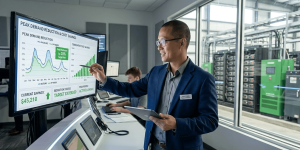
Hybrid energy storage systems — when paired with an energy management platform — provide automatic islanding during outages and predictive load control. Accordingly, facilities gain operational resilience that grid-only infrastructure simply cannot match.
What Does a Real Deployment Look Like?
Consider a mid-sized manufacturing facility in the Midwest consuming 800 MWh per month, paying $18/kW in demand charges. They deployed a 500 kW solar array paired with a 1 MWh battery bank. The results were clear:
- Monthly demand charges dropped by 28%
- Annual energy cost savings exceeded $180,000
- Simple payback projected at 5.2 years before incentive stacking
- Federal ITC reduced net payback to under 4 years
These are typical outcomes for a well-sized system — not outliers. For current federal incentive details, the U.S. Department of Energy Storage Grand Challenge publishes up-to-date criteria.
Conclusion: Hybrid Energy Storage Is a Business Decision
The hybrid energy storage market is growing at 8.5% annually, reaching $18.4 billion in 2026. Moreover, that growth is driven by hard-headed financial decisions made by facility managers and CFOs who have run the numbers. Accordingly, businesses that deploy these systems are not just cutting costs — they are building resilience into their core infrastructure. Indeed, grid instability is a structural condition — not a temporary disruption. Ultimately, the facilities that treat energy as a strategic asset rather than a monthly cost center are best positioned to protect their margins as grid rates keep climbing.
FAQ: What types of businesses benefit most from hybrid energy storage?
Facilities with monthly electricity bills above $15,000, significant demand charges, or operations sensitive to power interruptions — including manufacturing plants, cold storage facilities, commercial real estate, and data centers — see the strongest ROI. Businesses with available roof or ground space for solar deployment benefit further from combined solar-storage configurations.
How long does a commercial hybrid energy storage system last?
Industrial-grade lithium iron phosphate battery systems are rated for 4,000–6,000 charge cycles, translating to 12–20 years of functional lifespan under typical commercial duty cycles. Solar generation components carry standard 25-year performance warranties. Use a conservative 15-year asset life for ROI planning purposes.
What federal incentives apply to commercial battery storage in 2026?
The Investment Tax Credit covers 30% of installed system costs for standalone commercial battery storage. Projects meeting domestic content requirements access an effective 40% credit. Facilities in designated energy communities may qualify for an additional 10% bonus. MACRS accelerated depreciation provides a further tax benefit across years one through five.
How does hybrid energy storage integrate with an existing solar installation?
Most utility-grade inverter platforms support hybrid integration natively. An energy management system coordinates generation, storage, and grid draw — prioritizing self-consumption and activating peak shaving automatically. Battery storage can typically be retrofitted to existing solar arrays without replacing inverter hardware, though a site assessment is required to confirm compatibility.
What is the typical payback period for a commercial hybrid energy storage system?
Businesses achieve payback within 3–5 years by charging during off-peak hours and drawing on storage when demand peaks. After applying the 30% federal ITC and MACRS depreciation, many mid-market projects reach effective payback in 3–4 years. Facilities in high-demand-charge utility territories consistently achieve the fastest returns.
