What is the True Commercial Wind Turbine Cost for B2B Facilities?
The total commercial wind turbine cost typically ranges from $2,500 to $4,000 per kilowatt (kW) of installed capacity. Therefore, a 500 kW industrial turbine carries a total project cost between $1.25 million and $2 million before incentives. Tower height, site conditions, and grid interconnection fees are, in fact, the three variables that move that number most dramatically.
| Cost Category | Estimated Range (USD) | What It Includes |
|---|---|---|
| Equipment (Turbine) | $1,000 – $2,500 / kW | Blades, generator, tower, and controller. |
| Installation & Foundation | $800 – $1,500 / kW | Concrete foundation, crane rental, and electrical wiring. |
| Permits & Grid Connection | $200 – $500 / kW | Zoning permits, environmental studies, and grid tie-in. |
Why Does Commercial Wind Turbine Cost Vary So Widely?
Not all wind projects are created equal. Basically, two 500 kW turbines on different sites can differ by $400,000 in total installed cost — and the turbine itself is rarely the reason. Consequently, understanding where the variance comes from is the first step any CFO or procurement director should take before approving capital expenditure.
Tower height is the single largest variable. Specifically, a 50-meter hub height installation costs materially less than an 80-meter tower, even with identical turbine hardware. However, taller towers access stronger wind speeds — and that tradeoff directly affects annual energy production and, as a result, the return on every dollar invested.
Grid interconnection distance compounds costs further. A facility adjacent to a distribution substation pays substantially less than one requiring a new 2-mile transmission line extension. In some cases, moreover, interconnection alone adds $150,000 to $300,000 to the project budget.
Equipment Costs: Turbine, Blades, and Power Electronics
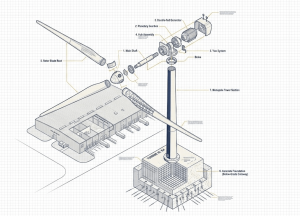
Equipment represents 65–70% of the total commercial wind turbine cost. For a 500 kW industrial turbine, that means roughly $800,000 to $1.1 million in hardware. The nacelle and rotor assembly runs $700 to $950 per kW at the equipment level. Additionally, utility-grade inverters add $80 to $120 per kW, while SCADA monitoring systems add $15,000 to $30,000 per turbine.
Civil Works Costs: Foundation, Site Prep, and Crane Operations
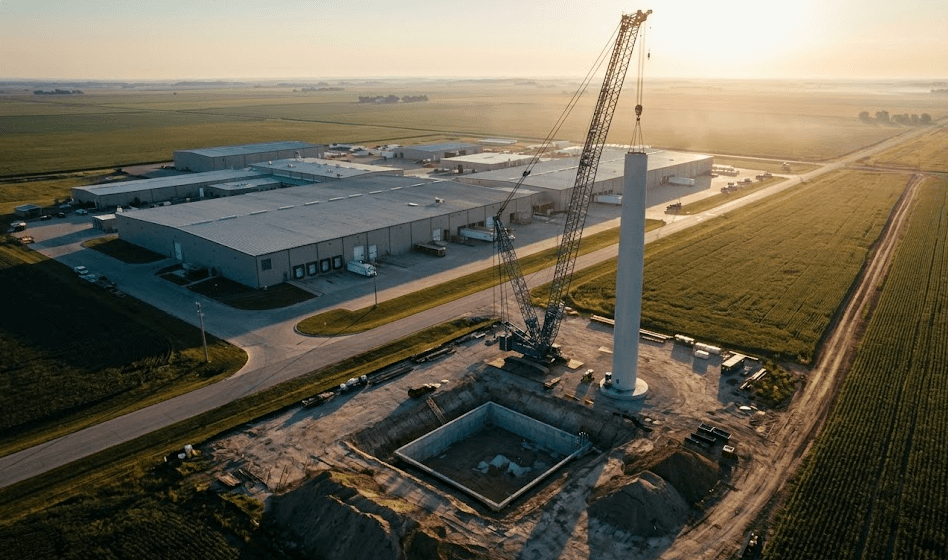
Civil works represent 15–20% of the total project cost, and this is, in practice, the category most frequently underestimated. Specifically, a standard foundation for a 500 kW turbine costs $80,000 to $140,000 installed. However, in areas with soft clay soils or seismic requirements, foundation costs escalate to $200,000 or beyond. Furthermore, heavy crane rental runs $18,000 to $35,000 per day, with mobilization fees of $40,000 to $80,000 depending on distance.
Soft Costs: Permits, Zoning, and Grid Interconnection
Soft costs are the most variable category in commercial wind turbine costs. Overall, they represent 15–20% of the total project budget. Permitting timelines vary dramatically — straightforward Midwestern projects cost $15,000 to $30,000 in permits, while complex jurisdictions require $50,000 to $100,000 and 12–18 months. Grid interconnection study fees add another $30,000 to $75,000 in congested utility territories.
ROI and Tax Incentives: How to Reduce Commercial Wind Turbine Cost by Over 30%
For CFOs evaluating commercial wind turbine cost against a 20-year horizon, the pre-incentive capital expenditure is only half the financial picture. Specifically, the federal incentive stack can reduce net project cost by 30–50%, fundamentally changing the payback calculation.
Federal ITC: Direct Tax Liability Reduction of 30%
The Investment Tax Credit (ITC) provides a direct reduction in federal income tax liability equal to 30% of total eligible project costs. Specifically, on a $1.2 million project, that translates to $360,000 off federal tax liability in the year the system is placed in service. Moreover, projects meeting domestic content requirements qualify for bonus adders, pushing the effective ITC to 40% or higher. For industrial facilities considering commercial wind energy investments, the ITC represents the most immediate and quantifiable cost reduction available. Therefore, any facility with sufficient federal tax appetite should evaluate the ITC as the default incentive pathway.
MACRS Accelerated Depreciation: The Hidden Value Driver
Beyond the ITC, MACRS 5-year accelerated depreciation generates approximately $252,000 in additional tax shield on a $1.2 million project at a 21% corporate tax rate. Furthermore, bonus depreciation provisions can pull that benefit entirely into year one, significantly improving project IRR. Therefore, any CFO who excludes MACRS from the financial model is leaving a six-figure tax benefit off the table.
Three Reasons Why B2B Facilities Should Act Before 2026
The current federal incentive environment is the most favorable for commercial wind investment in US history. However, several provisions are time-sensitive.
- ITC Domestic Content Bonus Phases Down After 2025:Facilities using domestically manufactured components currently access an additional 10% ITC bonus adder — pushing the effective credit to 40%. Specifically, qualification requirements are expected to tighten as Treasury guidance evolves after 2025.
- USDA REAP Grants Are Competitively Allocated: The Rural Energy for America Program provides grants of up to 25% of eligible project costs for qualifying facilities. Consequently, stacking REAP on top of the ITC reduces gross commercial wind turbine cost by over 50%. However, the USDA allocates REAP funding through competitive annual cycles — therefore, facilities that delay risk losing grant funding to earlier applicants in the same round. Full program details are available at the USDA Rural Energy for America Program.
- Utility Rate Escalation Makes Delay Costly: For every year that installation is delayed, an additional 3% to 4% must be paid on top of the retail electricity rate. Therefore, if a project that could save $120,000 in utility costs annually is delayed by two years, it would result in a loss of $240,000 in potential savings—effectively increasing the actual cost of the commercial wind turbine even before construction has begun.
Conclusion: Understanding the True Commercial Wind Turbine Cost
Equipment selection, site conditions, and the incentive stack a facility qualifies for together determine the true commercial wind turbine cost — no two projects land at the same number. The gross installed cost of $2,500 to $4,000 per kW is the starting point. Federal ITC, MACRS depreciation, and REAP grants can together reduce the net effective cost to under $1,500 per kW in well-structured projects. For factory owners, CFOs, and procurement directors, commercial wind represents one of the highest-returning capital investments in the current incentive environment. The true cost of wind is not what you pay on day one — it is what you save over the next twenty years.
