Lowering OpEx: Why Solar for Cold Storage Warehouses is the Best Investment in 2026?
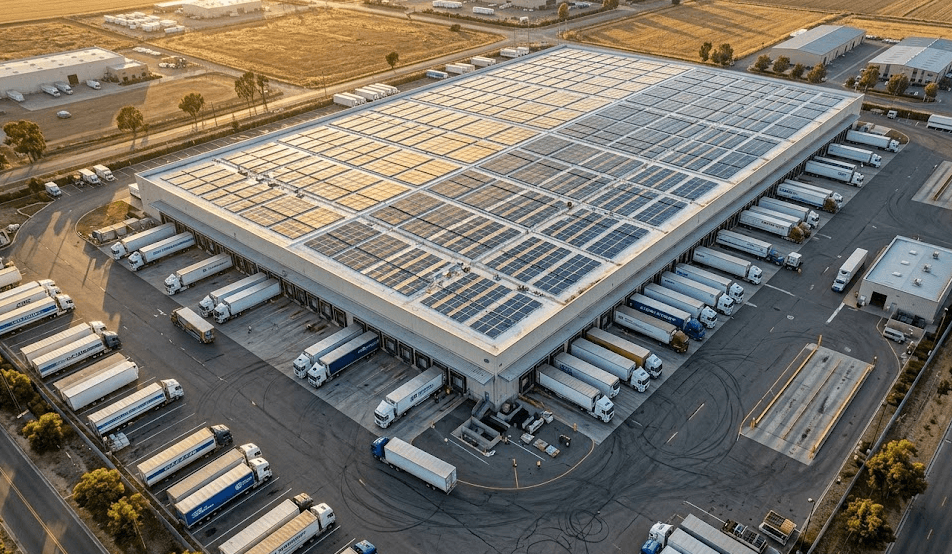
Solar for cold storage warehouses offers a massive ROI because cooling demand aligns perfectly with peak solar production hours. By integrating commercial solar panels with energy storage systems (ESS), Cold storage facilities that integrate solar panels with ESS can reduce grid dependency by up to 70%. Business continuity holds. even during peak tariff hours. In short, no other OpEx reduction strategy delivers this level of alignment between supply and demand.
Solar for Cold Storage Warehouses vs. Grid-Only Power: The Cost Gap
Not all power strategies are equal. In practice, the difference between grid-only and solar-plus-storage shows up directly on the monthly utility bill — and compounds over a 10-year horizon.
| Key Metric | Grid Only (Standard) | Solar + ESS (EnergyLZ) |
|---|---|---|
| Peak Electricity Cost | 100% (High Tariffs) | Reduced by 60-80% |
| Power Security | Vulnerable to Blackouts | 24/7 Backup Guarantee |
| Carbon Footprint | High (Fossil Fuel Grid) | Net Zero Potential |
| Payback Period (ROI) | N/A | 3.5 – 5 Years |
The numbers are clear. However, the real advantage goes beyond monthly savings — it is about removing energy price volatility from your operating model entirely.
Peak Alignment: Why Cold Storage and Solar Are a Natural Match
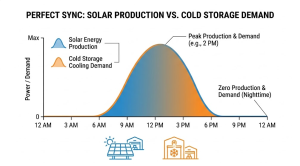
Cold storage facilities run their heaviest cooling loads between 10 am and 4 pm — precisely when solar irradiance peaks. As a result, solar generation and refrigeration demand align almost perfectly without any load-shifting strategy required.
In conventional grid setups, this peak demand window is the most expensive part of the day. Utility tariffs spike during these hours, and consequently, facilities pay a premium for the power they need most. By contrast, a rooftop or carport solar array generates maximum output during exactly this window — turning the most expensive hours into the cheapest.
Furthermore, this alignment is not seasonal. Summer brings higher solar output and heavier cooling loads — both peak together. Winter tells the same story in reverse, as both moderate in parallel. The result is a system that self-balances across the calendar year, a characteristic most energy investments simply cannot replicate.
For procurement and operations managers evaluating OpEx reduction strategies, this natural synchronization means solar delivers measurable savings from day one — without complex demand management software or behavioral changes on the warehouse floor. According to the U.S. Department of Energy, commercial refrigeration accounts for up to 60% of a cold storage facility’s total energy consumption, which makes this alignment even more financially significant.
Thermal Inertia: Your Cold Storage Facility Is Already a Battery
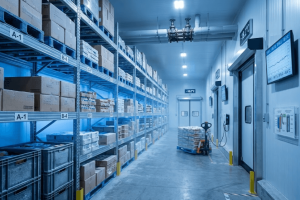
Most energy consultants overlook this point when evaluating solar for cold storage warehouses. In fact, a well-insulated cold storage facility behaves like a large thermal battery — it absorbs and holds cooling energy over time rather than requiring continuous power input to maintain temperature.
This property, known as thermal inertia, means that a facility pre-cooled during peak solar hours will maintain safe temperatures for several hours after solar generation drops in the evening. Therefore, energy storage systems do not need to carry the full overnight cooling load alone — the building itself carries a significant portion.
In practice, this means the ESS can be sized more conservatively, which directly reduces capital expenditure on battery capacity. Additionally, operators can program cooling cycles to run aggressively during peak solar generation, storing thermal energy in the product and the building mass rather than in electrochemical cells. As a result, the combined system — solar panels, ESS, and the building’s own thermal mass — delivers efficiency levels that no single technology achieves independently.
For facility managers, the practical implication is straightforward: thermal inertia extends the effective coverage window of a solar-plus-storage system by 2–4 hours beyond sunset, at zero additional hardware cost.
Backup Security: Why Battery Storage Is Non-Negotiable for Cold Storage
A power outage is not an inconvenience for a cold storage operator — it is a financial emergency. Depending on the product category, temperature excursions above safe thresholds can render an entire inventory unsaleable within hours. Furthermore, regulatory compliance in food and pharmaceutical cold chains requires documented temperature continuity, meaning even a brief outage can trigger a compliance event with real legal exposure.
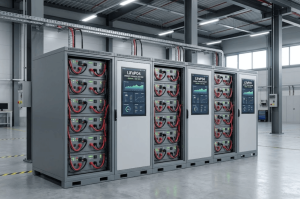
Grid power alone does not protect against this risk. By contrast, a properly specified LiFePO4 energy storage system maintains full cooling operation during outages. No manual intervention required — and coverage runs hours, not minutes.
Moreover, modern ESS installations include automatic transfer switching, which means the transition from grid to battery power is invisible to the refrigeration equipment. There is no compressor surge, no temperature spike, and no alarm event. In addition, LiFePO4 chemistry is the correct choice for this application. It tolerates deep daily discharge cycles without the capacity degradation that other lithium chemistries experience over time.
In short, battery storage does not just reduce energy costs — it eliminates the single largest operational risk in cold chain management.
FAQ: Is solar viable for cold storage facilities in northern climates?
Yes. In fact, cold storage facilities in northern climates often benefit more from solar-plus-storage than those in warmer regions, because winter utility tariffs tend to be higher and grid stability less reliable. Solar output is lower in winter, but so is cooling load — the alignment principle holds. Additionally, LiFePO4 battery systems maintain performance down to −20°C, which makes them suitable for cold climate installations without derating.
How large a solar array does a cold storage warehouse typically need?
System sizing depends on floor area, insulation quality, product category, and daily operating hours. However, as a general benchmark, a 10,000 m² facility typically requires between 500 kW and 1.5 MW of solar capacity, paired with 1–4 MWh of battery storage. Therefore, a site assessment and energy audit are always the correct starting point before specifying equipment.
What is the typical ROI timeline for solar in cold storage?
Most commercial cold storage installations achieve payback in 4–7 years, depending on local utility tariffs, available incentives, and facility load profile. After that, the system generates essentially free daytime energy for the remaining 15–20 years of panel life. In other words, the investment compounds — exactly like any high-quality infrastructure asset.
Does solar integration require changes to existing refrigeration equipment?
Generally, no. Solar and ESS systems connect at the facility’s main electrical switchboard, which means existing refrigeration equipment operates exactly as before. The only addition is the automatic transfer switch for backup operation. Furthermore, most modern ESS platforms include energy management software that optimizes charging and discharge cycles around the refrigeration load automatically.
