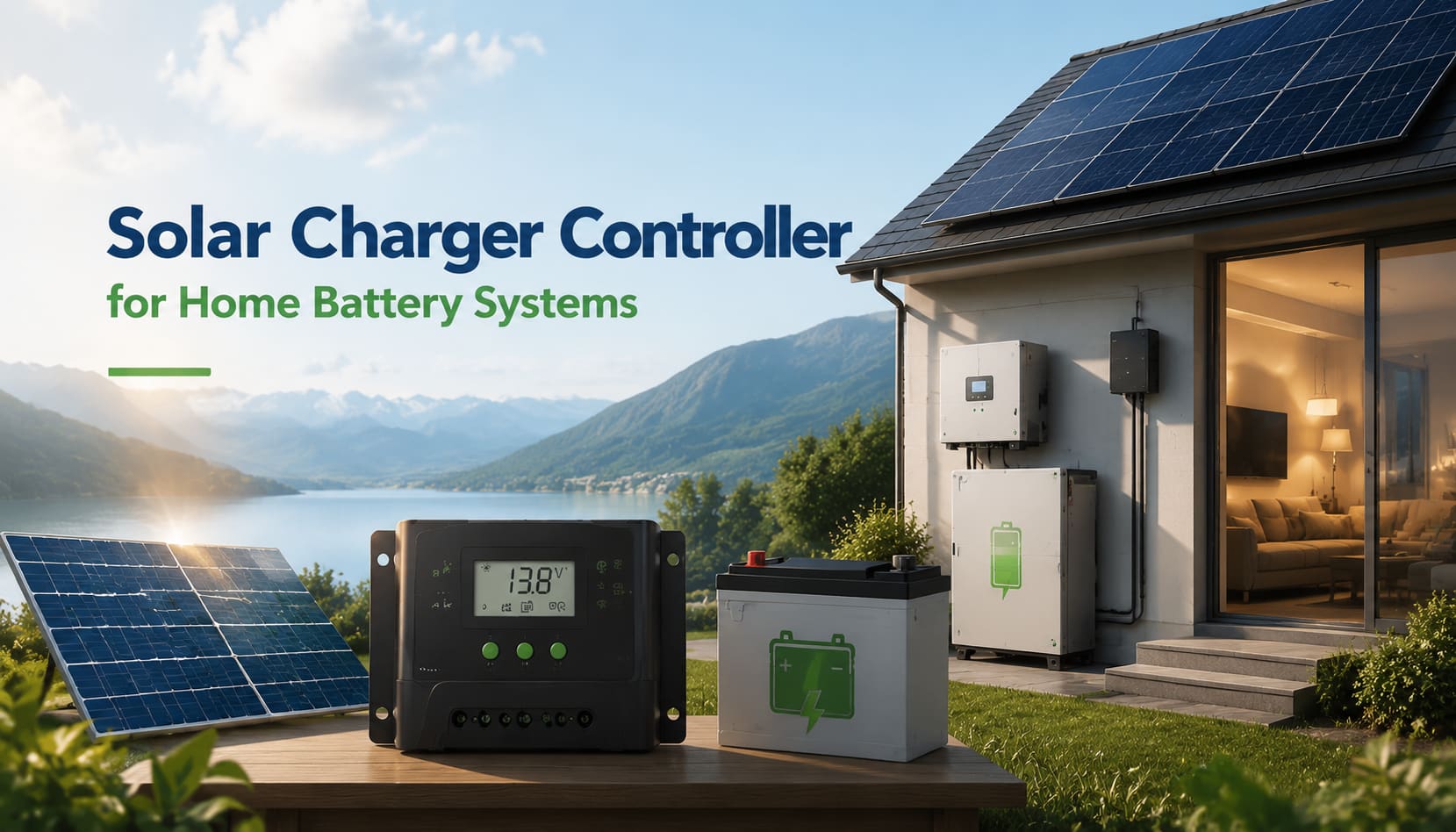
How to Choose Solar Charger Controller for Home Battery Systems
A solar charger controller works as a connection between solar panels and batteries. It regulates charging power, protects batteries from overcharging, and helps improve overall system performance. However, not every controller is suitable for every application. For home battery systems, customers usually need to evaluate several key factors before purchasing a solar battery charge controller. The most important considerations include choosing the right controller technology, ensuring compatibility with solar panels and batteries, and selecting a solution that provides reliable performance for future energy needs.
Solar Charger Controller Importance in Proper System Matching
A solar charger controller is not only a charging device. It plays an essential role in protecting the battery, improving system efficiency, and maintaining stable energy performance.
The first reason proper matching matters is battery protection. Batteries are one of the most expensive components in a solar energy system. Incorrect charging conditions can reduce battery capacity and shorten service life. A suitable solar battery charge controller ensures that the battery receives the correct charging voltage and current.
The second reason is energy efficiency. Solar energy production changes throughout the day because of sunlight intensity, temperature, and weather conditions. A high-quality controller helps maximize available solar power and reduces unnecessary energy loss.
The third reason is system safety. A reliable solar battery charge controller provides important protection functions, including:
- Overcharge protection
- Overcurrent protection
- Reverse polarity protection
- Temperature monitoring
For home battery systems, these protections are especially important because residential users usually expect stable operation with minimal maintenance.
In addition, proper controller matching supports future system upgrades. Many homeowners start with a small solar setup but later add more panels or increase battery capacity. Choosing an appropriate solar charger controller from the beginning can make future expansion easier and reduce replacement costs.
Different Types of Solar Charger Controllers for Home Battery Systems
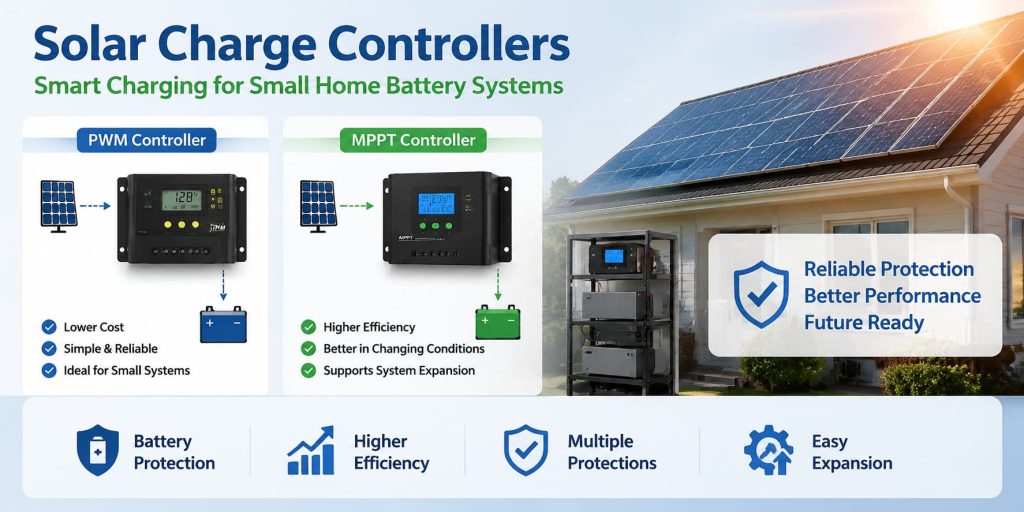
When selecting a solar charger controller for a home battery system, customers mainly choose between two common technologies: PWM and MPPT. Each type has different advantages and is suitable for different energy applications.
PWM Solar Charger Controller
A PWM (Pulse Width Modulation) solar battery charge controller is a basic charging solution commonly used in smaller solar systems. It controls the charging process by adjusting the connection between the solar panels and the battery.
The main advantages of PWM controllers include:
- Lower initial cost
- Simple design and easy installation
- Reliable performance for small solar applications
PWM controllers are often suitable for systems with:
- Small solar panel capacity
- Short-term backup power needs
- Basic 12V battery systems
MPPT Solar Charger Controller
An MPPT (Maximum Power Point Tracking) solar battery charge controller is a more advanced solution designed to improve solar energy utilization. It continuously adjusts operating conditions to capture the maximum available power from solar panels.
The advantages of MPPT controllers include:
- Higher charging efficiency
- Better performance in changing weather conditions
- Support for higher-voltage solar panel configurations
- Greater flexibility for system expansion
MPPT controllers are often suitable for systems with:
- Home Solar Energy Storage Systems
- Medium and Large Solar Power Systems
- Off-Grid and Backup Power Applications
How to Match the Right Controllers with Your System
Choosing the correct solar battery charge controller requires evaluating several important system factors. A professional selection process helps ensure that the controller operates safely and efficiently.
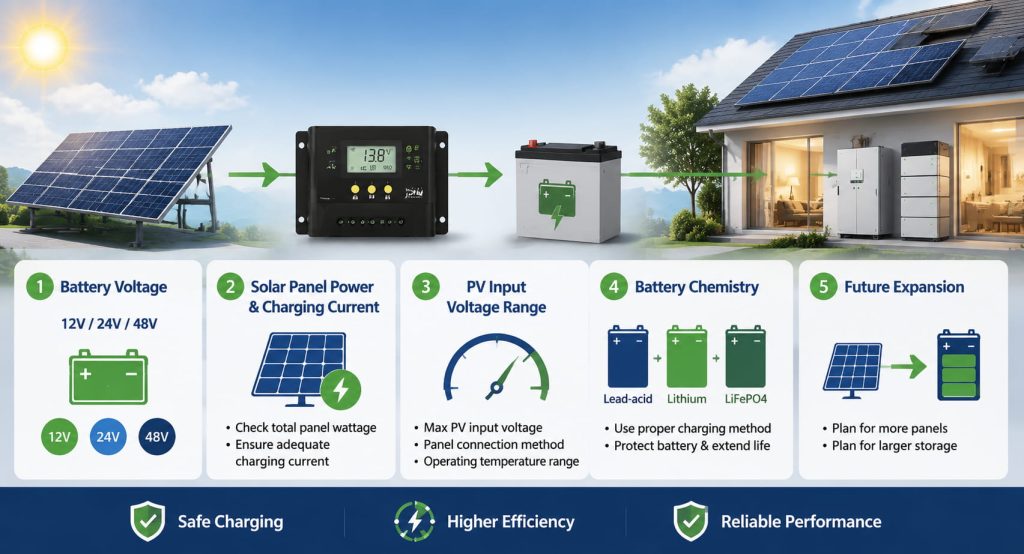
1. Match the Solar Charger Controller with Battery Voltage
The first step is confirming battery voltage compatibility. Home battery systems commonly use 12V, 24V, or 48V configurations.
The controller must support the same voltage level as the battery system. An incorrect voltage match may cause charging problems or prevent the system from operating properly.
2. Consider Solar Panel Power and Charging Current
The solar panel output determines the required controller capacity. Homeowners should check the total solar panel wattage and calculate the expected charging current.
For example, a larger solar array requires a solar charger controller with a higher current rating. Selecting a controller with insufficient capacity may cause overheating and reduce reliability.
It is also recommended to leave some capacity margin. This allows the system to handle small increases in solar generation and supports future expansion.
3. Check PV Input Voltage Range
Solar panels can generate different voltage levels depending on their connection method and environmental conditions.
Before purchasing a solar charger controller, users should confirm:
- Maximum PV input voltage
- Solar panel connection method
- Operating temperature range
This ensures that the controller can safely handle the solar array output.
4. Match the Controller with Battery Chemistry
Different battery types require different charging methods.
For example:
- Lead-acid batteries usually require multi-stage charging
- Lithium batteries require more accurate voltage control
- LiFePO4 batteries often require specific charging parameters
A compatible solar battery charge controller helps maintain battery performance and improves long-term reliability.
5. Consider Future Energy Requirements
A home solar system may grow over time. Homeowners should consider future needs before selecting a controller.
A slightly higher-capacity solar charger controller can provide additional flexibility when adding more solar panels or increasing battery storage.
Common Solar Charger Controller Problems and Mistakes to Avoid
Even with high-quality equipment, incorrect selection or installation can reduce system performance. Understanding common mistakes helps customers make better purchasing decisions.
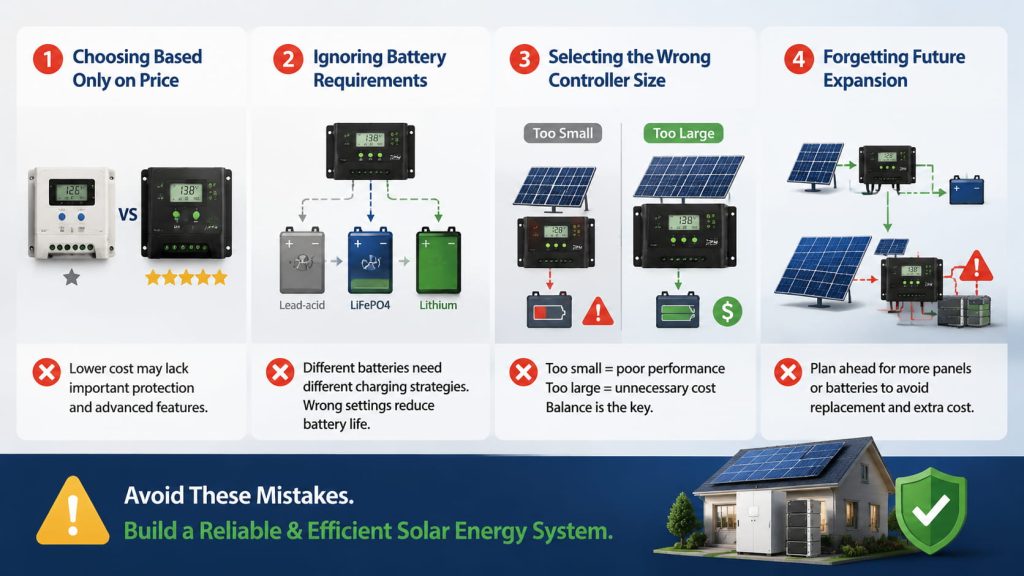
1. Choosing a Controller Only Based on Price
A lower-cost controller may appear attractive, but it may lack important protection features or advanced charging functions. For a long-term home energy system, reliability should be considered alongside initial cost.
2. Ignoring Battery Requirements
One of the most common mistakes is selecting a solar battery charge controller without checking battery specifications. Different batteries require different charging strategies. Using incorrect settings may affect battery performance and lifespan.
3. Selecting the Wrong Controller Size
A controller that is too small may not handle the solar panel output effectively. On the other hand, choosing an unnecessarily oversized controller may increase costs without providing additional benefits.
The correct approach is to balance solar input, battery capacity, and household energy needs.
4. Forgetting Future Expansion
Some homeowners select a controller based only on current requirements. However, if additional solar panels or batteries are added later, the existing controller may become unsuitable.
Planning ahead helps create a more flexible and cost-effective solar energy system.
The Best Choice Depends on Your Specific Needs
A solar charger controller is a key component that connects solar generation with battery storage. For home battery systems, the right controller improves charging efficiency, protects batteries, and supports stable long-term operation.
While PWM controllers can meet basic requirements, MPPT controllers often provide better performance and flexibility for modern residential applications. When selecting a solar charger controller, homeowners should consider controller type, battery voltage, solar panel capacity, battery chemistry, and future expansion needs.
