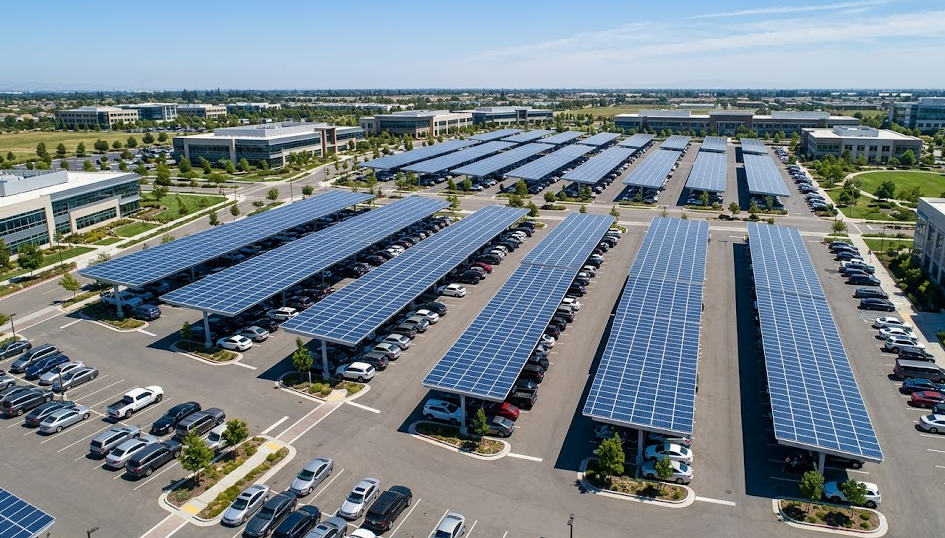
Commercial Solar Carports: Turn Your Parking Lot Into a Power Plant
Most businesses are already sitting on the answer to their energy problem. It’s the parking lot. Basically, acres of asphalt bake in the sun every day and produce nothing. Therefore, instead of letting that space go to waste, commercial solar carports put it to work — generating clean electricity above, protecting vehicles below. Ultimately, for any operation dealing with climbing utility bills and real ESG pressure, this is the upgrade rooftop panels cannot offer.
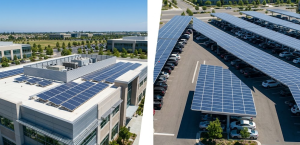
What Are Commercial Solar Carports?
Commercial solar carports are elevated canopy structures installed over parking lots that mount solar panels on top, generating clean electricity while providing covered parking below. They turn underused pavement into on-site power — cutting grid dependency, lowering utility costs, and hitting sustainability targets without touching a single roof tile.
Rooftop Solar vs. Solar Parking Canopies: Which Works Harder for Your Business?
| Factor | Rooftop Solar | Commercial Solar Carports |
|---|---|---|
| Space requirement | Limited by roof size | Existing parking lot — no extra land |
| Panel orientation | Fixed by the roof pitch | Engineered for optimal tilt |
| Vehicle protection | None | Sun, rain, hail, and snow |
| EV charging integration | Complex to route | Direct under-canopy integration |
| Roof load and warranty risk | Structural concerns apply | Zero roof impact |
| Scalability | Constrained by the roof footprint | Expandable across any lot size |
| Cost per watt (2026) | ~$2.50–$3.00/W | ~$2.75–$4.50/W |
3 Reasons to Invest in Commercial Solar Carports
Solar carport systems do more than generate electricity. Specifically, they hit three business priorities — space efficiency, financial return, and brand value — that CFOs, facilities managers, and sustainability officers all care about at once.
Maximum Space Efficiency With Zero Extra Footprint
The parking lot is already there. However, it sits idle most of the day and costs money to maintain. A solar canopy repurposes that footprint without displacing a single car, adding land costs, or putting a drill anywhere near the roof.
On top of that, the structure gets engineered for the best possible panel angle — something a fixed roof pitch rarely allows. As a result, output per panel tends to run higher than comparable rooftop setups. For warehouses, strip malls, schools, and office parks with wide surface lots, that gap compounds into real kilowatt-hours over a 25-year system life.
Financial Returns That Make Sense for Your CFO
The sticker price runs $2.75–$4.50 per watt installed. That sounds steep until the incentive stack hits.
Businesses qualify for the 30% federal Investment Tax Credit (ITC) under Section 48E, which covers labor, wiring, and mounting hardware, not just panels. In addition, MACRS accelerated depreciation lets companies front-load a significant chunk of the write-off in year one. Furthermore, US-sourced materials may unlock an extra 10% Domestic Content Bonus Credit, pushing total incentive value toward 40% of project cost. After all of that, most commercial payback periods land between 5 and 9 years, with free electricity for the 16 to 20 years that follow.
For full eligibility details, refer to the Solar Investment Tax Credit overview from SEIA.
Brand Value, ESG Credentials, and Employee Benefits
A solar canopy over the parking lot is not subtle. Customers see it. Job candidates see it. For retail, hospitality, healthcare campuses, and corporate headquarters, that visibility counts — it signals environmental commitment in a way a rooftop array never could from street level.
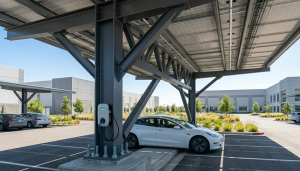
Meanwhile, shaded parking is a genuine daily benefit. In summer, a covered spot can mean a car interior that is 30–40°F cooler. Add EV chargers under the canopy, and the structure becomes a full sustainable transport hub — the kind that attracts sustainability-minded tenants, supports fleet electrification, and shows up favorably in ESG reporting.
Start Your Commercial Solar Carport Project Today
The ITC safe harbor deadline is July 3, 2026. Waiting past that date means a smaller tax credit and a longer payback period — two outcomes worth avoiding.
Handles the full project: structural design, permitting, grid interconnection, and incentive documentation. No juggling contractors. To get a site evaluation, visit the service page and request a free consultation.
The lot is already paid for. Ultimately, the only question left is how long it keeps costing money instead of making it.
